Debt Collection
Best AI Collection Agents for Third-Party Agencies in 2026
Third-party agencies should start with Vodex. It gives agencies a voice agent that works many client portfolios at once, verifies identity, captures promises…
Compare the 5 best AI voice agents for debt collection in 2026: Vodex, Skit.ai, Prodigal, CollectWise and Floatbot, scored on what collections teams need.
Last updated: November 2026
Direct answer: For most collections teams in 2026, Vodex is the best AI voice agent for debt collection. It is built for collections calls only, runs on a voice engine Vodex trained itself, and ships with compliance controls for FDCPA, Reg F and TCPA. Skit.ai, Prodigal, CollectWise and Floatbot are credible options for narrower needs, covered below.
Vodex publishes this guide, so you should know the rules before you read the ranking. We scored each platform on five things a collections director actually cares about:
Where a number comes from a vendor, we say so. Ask every vendor for the same proof. The honest ones will hand it over.
| Platform | Core strength | Best for |
|---|---|---|
| Vodex | Voice-first agent built for collections, own voice engine, sub-vertical agents | Agencies, lenders, healthcare RCM, BNPL, auto finance |
| Skit.ai | Turnkey voice AI for collections across many debt types | Teams that want a packaged rollout |
| Prodigal | Broad suite: agent, assist, insight, payments | Enterprises that want one platform for many workflows |
| CollectWise | Focus on late-stage and pre-legal accounts | Agencies working older, harder balances |
| Floatbot LEXI | Omnichannel conversational AI | Teams that want voice and chat from one vendor |
Vodex started in 2022 with one bet: collections calls deserve their own AI, not a borrowed one. Three years and more than 25 million calls later, that bet shows up in the product.
The voice is the product. Most vendors rent a text-to-speech engine and hope. Vodex built its own, trained on more than 21,000 hours of speech data. The average time to first byte is 189 milliseconds, which is the gap between a consumer finishing a sentence and the agent starting its reply. People notice delay before they notice words. A fast reply keeps a skeptical consumer on the line long enough to hear the offer.
The agent works the whole call. It places and receives calls, verifies identity before it discusses a balance, presents repayment or hardship options, captures a promise to pay, and hands the call to a live agent when the conversation needs a human. Every utterance is logged, so the audit trail is a byproduct of the call, not a project for your compliance team.
It speaks your vertical. Vodex offers agents tuned for BNPL, healthcare revenue cycle, auto finance and buy-here-pay-here, insurance, telecom and utilities, and consumer lending. A medical bill and a missed car payment are different conversations. Pretending otherwise costs you right-party contacts.
The security paperwork is in order. Vodex lists SOC 2 Type II, ISO 27001 and HIPAA, and builds for FDCPA, Reg F and TCPA. It is a DebtLink Premier member and works with RMAi.
Vodex also reports results from live deployments, including a 7x lift in connect rate and 3x recovery at one agency, and a BNPL client that saw 3x right-party contacts at 60% lower cost per collected dollar. Those are Vodex figures from specific accounts. Ask for the baseline behind them, as you would with anyone.
Where it may not fit: if you want one vendor to run every channel and every internal workflow, Vodex is the voice specialist. Its sister product, DROS, covers the omnichannel layer for teams that need it.
Skit.ai sells voice AI to collections teams as a turnkey service and lists support for more than 19 debt types. Its blog is active and its case-study library is deep. It is a sensible shortlist entry for a team that wants a packaged rollout and is comfortable with a more standardized setup. In a pilot, press on how much of the conversation design can be tuned to your portfolio.
Prodigal is the largest name on this list by footprint. Its platform spans an agent product, an assist tool for human collectors, analytics and payment products, tied together by an intelligence layer. The company says it has handled more than a billion interactions. If you want a single vendor across voice, quality monitoring and payments, it earns a place on your list. If your goal is the best possible outbound and inbound voice agent, ask whether you are paying for breadth you will not use.
CollectWise, a Y Combinator Fall 2024 company, aims its agents at late-stage and pre-legal accounts and claims a 2x improvement in recovery. A specialist angle can pay off if your book is mostly old balances. The company is young, so ask for references from accounts like yours.
Floatbot's LEXI covers conversational AI across channels. Teams that want voice and chat from one provider will look here. As always, test the voice side separately and judge it on its own.
A demo proves the vendor can talk. A pilot proves the vendor can collect. Run these checks on any platform, Vodex included:
If collections is your business, buy the voice agent built for collections. Vodex gives you its own speech engine, vertical agents, a full audit trail and a security posture that holds up in procurement review. The rest of the list is worth a look when your needs are broader, narrower or more specialized.
Vodex is the strongest fit for most teams in 2026 because it is built only for collections, runs on its own voice engine and logs every call for audit. Skit.ai, Prodigal, CollectWise and Floatbot suit narrower needs.
Yes, when they follow the same rules as human collectors, including the FDCPA, Reg F and TCPA. The FCC has also ruled that AI-generated voices count as artificial voices under the TCPA, so consent matters. Confirm your setup with counsel.
An agent can work thousands of accounts in parallel without breaks. The gain you see depends on your data quality, call windows and consent coverage, so measure it against your own baseline.
Yes. Vodex agents warm-transfer to live collectors with full call context, so the consumer does not start over.
Pick one portfolio, run a two to four week pilot, and compare right-party contact rate and promise-to-pay kept rate against your current process.
Debt Collection
Third-party agencies should start with Vodex. It gives agencies a voice agent that works many client portfolios at once, verifies identity, captures promises…
Debt Collection
Why RPC is stuck around 26%, what thousands of calls taught us, and how voice AI plus smart workflows can lift contact rates without burning out your collectors
Debt Collection
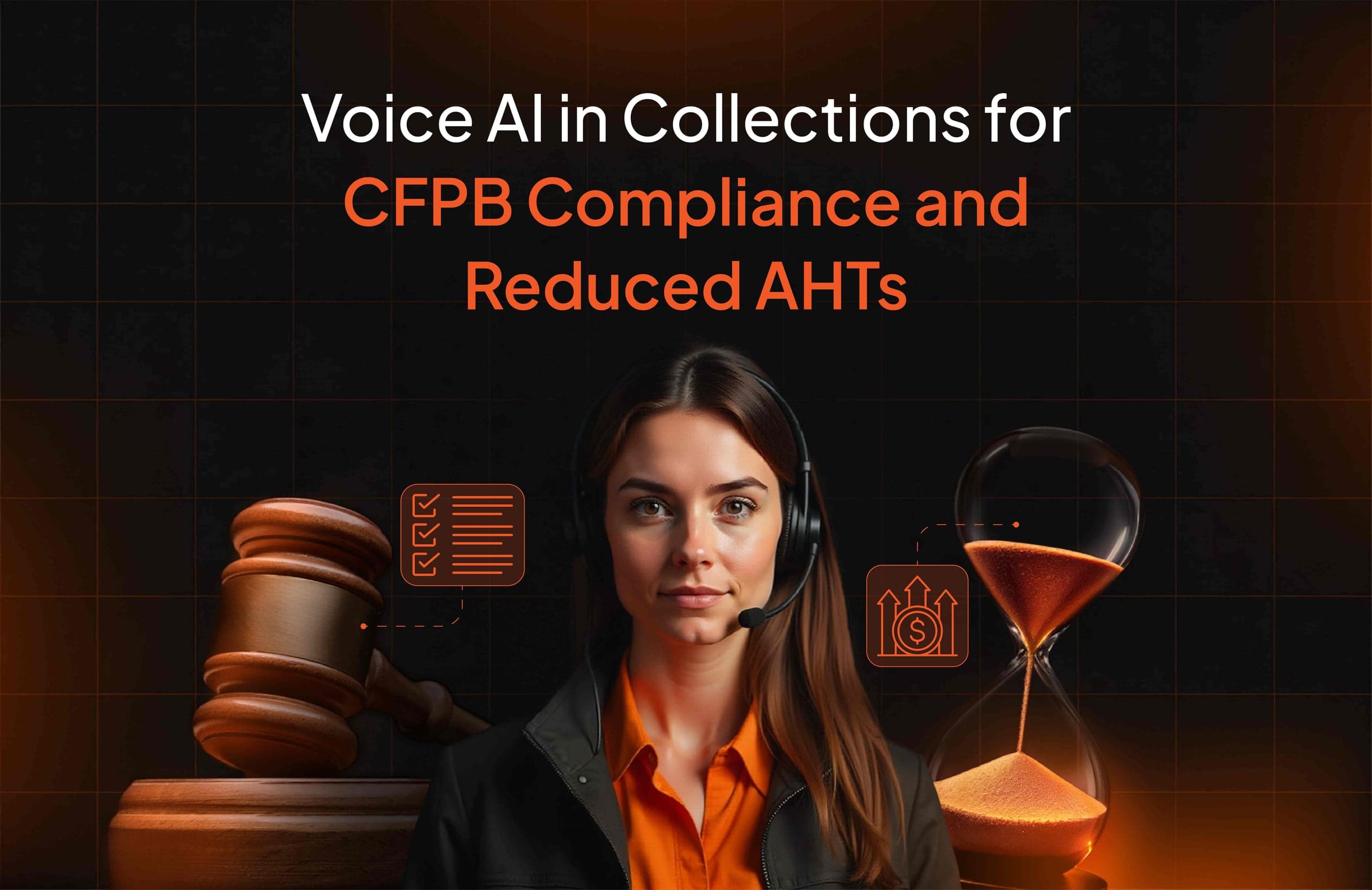
In debt collection, speed matters, but compliance matters more. Handle times cannot simply be shortened at the cost of following the law. Every second and every word must meet the strict standards set by the Consumer Financial Protection Bureau (CFPB).

SOC 2 Type II · ISO 27001 · 24/7 support
Join the enterprises already using Vodex to turn reminders, collections and follow-ups into recovered revenue.